So you’re wondering how to make coffee jelly? Well, the first question then, is what on God’s green earth is coffee jelly??
This blog is written for the good people of the United States of America, but it’s written by a Brit, as you may know. I started off with my UK blog, coffeeblog.co.uk, I then launched my Coffee Kev Youtube Channel, and of course thanks to YouTube I ended up with a growing American audience, and CoffeeKev.com was created just for you :-).
There are some topics that come up which are mainly American phenomena, or have started off in the USA and haven’t yet reached the UK. Actually, it’s kind of the opposite with coffee jelly, as this is something that started in the UK but moved to the US, and is still quite a thing in some parts of America, but became very popular in Japan and is now becoming popular again particularly in America as a Japanese import.
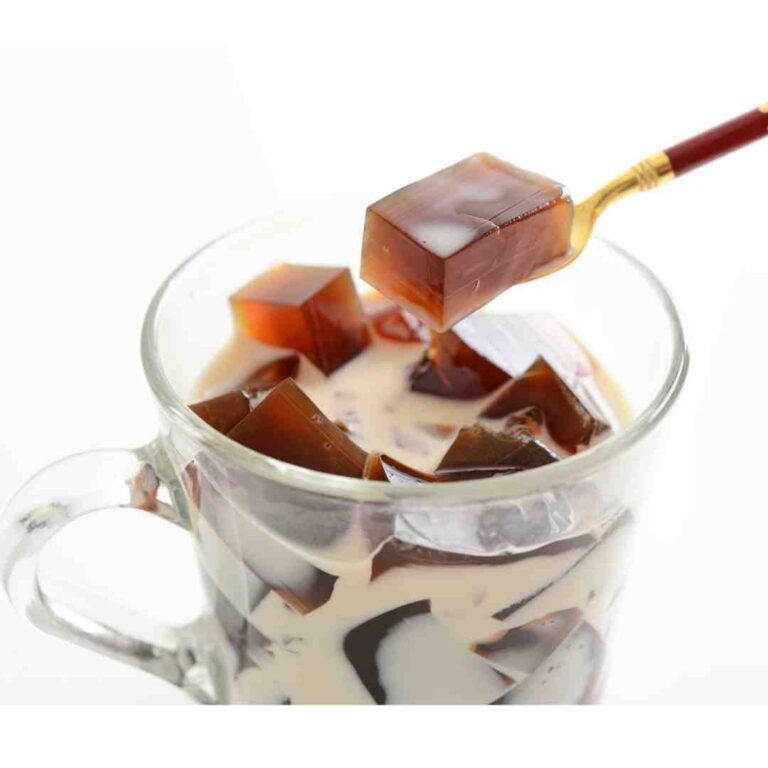
Coffee Jelly is thought to have originated in the UK, well, the first recorded recipes are from England in the early 1800s, and was simply coffee mixed with calves’ foot jelly (nice…) and later mixed with pre-packed gelatin once that became a thing, and then simply put into a mold to set.
It was included in a medical book in the early 1900s published in England, which appeared to promote coffee jelly as a healthy dessert to consume, with the idea that the gelatin would help to absorb excess stomach acid.
It fell out of fashion in the UK way before my time, though, but it became a thing in America, mainly in New England where you would still have found it on the menu in some restaurants in Rhode Island, Massachusetts, and Boston even before the recent resurgence.
Japanese coffee jelly grew in popularity within the Taishō period in the early to mid-1900s, appealing to younger Japanese people with western fashion tastes, and grew along with Japan’s café culture. It has remained widely popular in Japan, where it’s often on the menu along with bubble tea, and is served chilled usually with whipped cream or milk.
Why it turned into such a craze in Japan in recent years and is now making its way across the world is probably at least in part thanks to Starbucks putting coffee jelly frappuccino on their menu in Japan in 2015, initially as a short-term menu item.
Coffee Jelly drinks have also hit Starbucks menus in various other parts of the world including Thailand and Indonesia, which is probably the catalyst for the coffee jelly craze.
What is coffee jelly made of?
Essentially coffee jelly is simply gelatinized coffee, basically, Jell-o made with coffee, made by mixing coffee with a setting agent such as animal gelatin or a vegan alternative like Agar Agar.
How can you use coffee jelly?
This is what interests me the most about coffee jelly, as a thing on its own it’s just jelly made of coffee, but to me, it would make for a really interesting base, or at least an addition, for various deserts.
Starbucks has used coffee jelly as a base for a different kind of frappuccino, which I’m guessing makes for an interesting addition, especially where texture is concerned. It’s commonly consumed in Japan in bubble tea cafes simply put into glasses or cups in cubes with milk or cream, but I would imagine that this is a really versatile coffee based wobbly wonder stuff that would potentially enhance any cold coffee beverage.
If you’re making your own, you can make it with whatever coffee you like, and you can make it as sweet as you prefer simply depending on how much sugar you use, so you could, for example, make a sweet coffee jelly to cut into small cubes and plop into your cold brew as a way to add a bit of interesting texture and sweetness to your refreshing cold brew.
You could include it in a wide range of desserts, as coffee is usually such a great way to balance the sweetness. One idea I have for a really simple way to use coffee jelly in a desert, and of course, I will try this – is to make a version of the dessert Caffe Reale.
This is a dolcetto, a mini dessert that is found on some restaurant menus, often with coffee. It’s Mascarpone with miniature figs in spiced syrup, often served with an espresso on the side. I love this dessert, but I can imagine that a few cubes of coffee jelly would really raise this little coffee desert to the next level!
Another idea that springs to mind is Kapuziner Kaffee, the original Austrian spiced coffee and whipped cream drink that was imported just over the border into Italy after the invention of the espresso machine, where it became known as the cappuccino.
I mentioned in my video in which I made the original 1700s version of Kapuziner Kaffee, that it seemed more like a dessert to me but it had the taste of a spiced latte.
I can imagine that a form of this drink with the inclusion of coffee jelly would be a winner for the taste buds!
There are also various forms of coffee custard that I think could be enhanced with coffee jelly. Crème caramel with coffee jelly cubes inside, for example, or any Turkish coffee custard I would think would be even better with coffee jelly!
Is coffee jelly good for you?
I think this probably depends, it probably depends on who you ask, the person who is consuming it, how the coffee jelly is made and what else is in it, and what you consume it with.
Coffee jelly is simply coffee mixed with some form of thickening agent. If you’re making the coffee jelly yourself then how good or bad for you it is will largely depend on what else you put in it.
As far as the coffee itself goes, if you’re using freshly brewed coffee that you’ve brewed yourself, then there is of course the caffeine to consider, but you should be able to roughly work out how much caffeine each cube contains based on the approximate caffeine content of the coffee you brewed simply divided by how many cubes you cut the coffee jelly into.
So if you use the equivalent of two cups of coffee at approx. 100mg per cup, you would simply divide 200mg by however many cubes you cut it into.
There’s also the gelatin to consider, and I don’t eat meat personally (I haven’t done since 2009) so for me now the thought of using a product made from Animal bones seems a bit weird, but where health is concerned, gelatin is often considered a rich source of protein and as being potentially good for bone and joint health.
I would make this using Agar Agar, I would imagine, and this is known to be high in fiber and iron and comparatively low in calories. See Agar Agar health benefits and uses.
After this, it would just depend on what you’re consuming with the coffee jelly, such as cream, milk, and so on.
How long can coffee jelly last?
Storing coffee jelly is easy if it lasts for long enough for you to need to store it ;-). You can make a frozen version and keep it in the freezer, or you can make a chilled version and just keep it in an airtight container and keep it in the fridge, where it should be good for up to around three days.